Pengikut

Selasa, 01 Februari 2011

Lahti L-39 "Norsupyssy" anti-tank rifle (Finland)
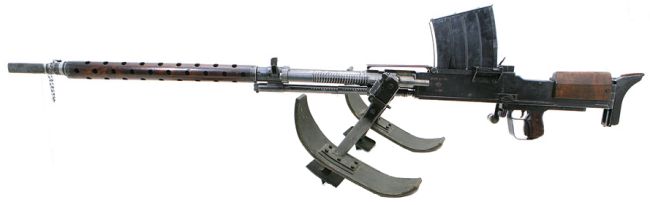
Lahti L-39 "Norsupyssy" anti-tank rifle (Finland)

Lahti L-39 "Norsupyssy" anti-tank rifle.

Type / action semi-automatic, gas operated
Caliber 20x138B
Weight unloaded 49.5 kg
Length 2240 mm
Barrel length 1300 mm
Magazine capacity 10 rounds
Armor penetration (Range / Angle / Penetration) 100 m / 90o / 30 mm; 300 m / 90o / 25 mm

The L-39 antitank rifle (official Finnish designation 20 pst kiv/39, unofficial "Norsupyssy" - elephant gun) was developed by famous Finnish arms designer Aimo Lahti on request from Finnish army. Early prototypes were built around proprietary 20x113 ammunition, also designed by Lahti, but in mas production this was changed to more common 20x138B ammunition, which was more powerful, has wider selection of loadings (AP, AP-T, AP-HE, Incendiary etc), and was also common with 20mm AA guns, bought from Germany. About 1 800 of these guns were produced by VKT factory during the WW2, and although 20mm shells were rather ineffective against Soviet T-34 and KV tanks, Finnish army made a good use of this weapon to fight light armor, bunkers and other targets of importance. In 1944, an 'anti-aircraft rifle', known as 20 it kiv/39-44, was developed from the L-39, by adding select-fire capability and simple anti-aircraft mount. It must be noted that Finnish army kept its stocks of Lahti L-39 anti-tank rifles well after the WW2 - many were surplussed and sold to USA in early 1960s and last ones were scrapped or sold as surplus in mid-1980s.
Lahti L-39 anti-tank rifle is a semi-automatic, gas operated weapon. Gas piston is located below the barrel, and a manual gas regulator is provided in gas block. The bolt locking is achieved by vertically sliding locking block, which is installed in the bolt. When in battery, this locking block is forced up by cam surface in the bolt carrier to engage the slot cut in the receiver. After discharge, rearward movement of the gas piston and bolt carrier forces the locking block to fall down and unblock the bolt; after that, bolt is free to recoil along with bolt carrier. One unusual feature of the Lahti L-39 anti-tank rifle is that bolt remains open after each shot, which allows the barrel to cool down faster after each shot. Despite that, gun is fires from closed bolt, and the firing sequence after each shot involves two deliberate actions. First, shooter must squeeze grip lever (located below the trigger guard) to release bolt forward. Once bolt is fully locked, shooter can pull the conventional trigger and fire the gun. Feed is from detachable top-mounted magazines, ejection is to the bottom. To reduce the felt recoil, rifle is equipped with massive muzzle brake and a soft shoulder pad. Standard iron sights are fully adjustable and calibrated between 200 and 1400 meters. Lahti L-39 anti-tank rifle was equipped with unusual "dual" bipod, with two sets of legs, one with spiked shoes for use on more or less hard ground and another with skid-type shoes for use on soft ground or snow.

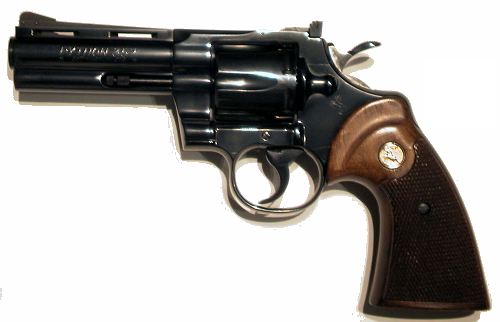
Colt "Python" (USA)

Colt "Python" (USA)

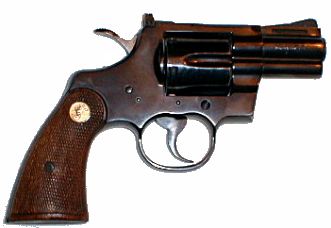
Colt 'Python' with 4 in (102mm) barrel
 
Colt 'Python' with 2.5 in barrel
 
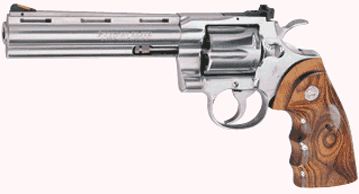
Colt 'Python Elite' with 6 in barrel

 
Type: Double Action
Chamber: .357 Magnum
Weight unloaded: ca. 1100 g (with 4 in barrel)
Length: 240 mm (with 4 in barrel)
Barrel length: 2.5, 4, 6 or 8 inches (64, 102, 153 or 203 mm)
Capacity: 6 rounds

The "Python" revolver was introduced by Colt company (USA) in 1955. It was awailable in different barrel lenghts, suitable for self-defence (2.5 and 4 in barels), service (4 and 6 in barrels), hunting and target shooting (4 - 8 in variants). Early "Pythons", especailly those without letters in the serial numbers (made from 1955 until mid-1960's) were indeed very accurate guns, often compared to Manurhin MR-73's or SIG P210's. Some time ago Colt discontinued the "Python" series in favor of the more modern "Kingcobra" revolver, but it is (probably) still available through Colt Custom Shop.
All Pythons were double-action, swing-out cylinder revolvers. Sights: blade post fron sight with polymer insert; rear sights with removable sight blade are screw ajustable for both windage and elevation. Barrel is screwed into the frame and featured vented upper rib and full-lenght bottom rib that houses full lenght extractor rod. Internal safety consist of Colt's patented transfer bar and cylinder stop (fixes cylinder when hammer is cocked).

DENEL PAW-20 "Neopup" handheld grenade launcher (South-Africa)

DENEL PAW-20 "Neopup" handheld grenade launcher (South-Africa)

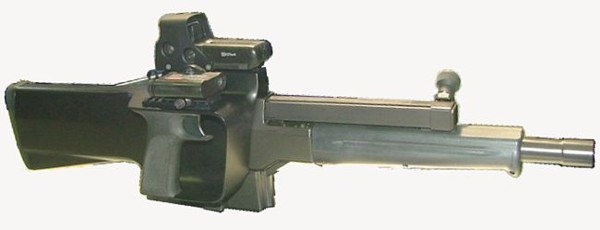
PAW-20 grenade launcher, right side. Note that it has dual Picatinny rails whichhost collimating (red dot) sight at left, and a laser pointer at right.
 PAW-20 grenade launcher, right side. Note that it has dual Picatinny rails whichhost collimating (red dot) sight at left, and a laser pointer at right.
 
PAW-20 with night vision sight and laser pointer. Note that magazine projectswell below its housing.
 PAW-20 with night vision sight and laser pointer. Note that magazine projectswell below its housing.
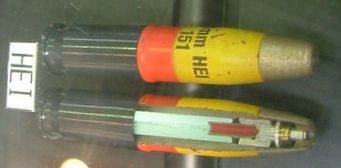
20mm ammunition for PAW-20 grenade launcher (shown are High Explosive Incendiaryrounds).
 20mm ammunition for PAW-20 grenade launcher (shown are High Explosive Incendiaryrounds).

Caliber: 20x42
Type: semiautomatic, magazine fed
Overall length: 845 mm
Weight: 5.9 kg unloaded
Effective range: up to 1000 m (area targets)
Magazine capacity: 7 rounds

PAW-20 (PAW stands for Personal Assault Weapon) is a most recent development of the South-African company Gemaco Elbree Pty Ltd, and is marketed by South African military corporation DENEL. Ammunition of new type,developed for PAW-20, is produced by the PMP - DENEL munitions. While in some advertising texts the PAW-20 was listed as a "new assault rifle",it is obviously not a true assault rifle, but,rather a semi-automatic grenade launcher, which is intended as an infantry support weapon. PAW-20 fires specially developed explosive ammunition of 20mm caliber, using relatively short, straight cartridge cases. Muzzle velocity is about 300 m/s, which is quite low by artillery standards but rather high by standards of hand-held grenade launchers. Intended targets for PAW-20 are infantry in the open and behind light covers, as well as unarmored or lightly armored vehicles and thin-walled buildings. While maximum effective range for PAW-20 is given as 1000 meters, it is obviously stated for "area"targets such as groups of soldiers; against point targets like cars or machine gun nests, effective range will be much less probably no more than 300-400 meters - unless gun will be used in conjunction with laser rangefinder and computerized sight with built-in ballistic calculator.
 Standard ammunition at this time is available in HE, HE-I and TP (practice)variety, with other types being in development. Weight of the round warhead is listed as 105 gram, and it seems that new round consists of a standard 20mmprojectile (as used in aircraft cannons) loaded into short, straight-walled case of 42mm length. All ammunition is point-detonating only, unlike the American XM-25, to which PAW-20 is a direct competitor.
PAW-20 is semiautomatic, gas operated weapon with rotary bolt locking. The entire barrel / bolt group is allowed to recoil within the polymer gun housing forabout 75mm (3"), in attempt to decrease peak recoil down to manageable level. General layout of the gun is somewhat unusual as the pistol grip with thetrigger is located at the right side of the receiver. Gun is fed from detachable box magazines which hold 7 rounds of ammunition. Empty cartridge cases areejected through the window on the left side of the weapon, right in the front of the firer's face. Sighting equipment is installed on two Picatinny-type rails located in parallel at the top of the gun housing. Preferred sighting arrangement seems to be a red-dot type collimating sight, but other sight options also available.

BXP (South Africa)

BXP (South Africa)

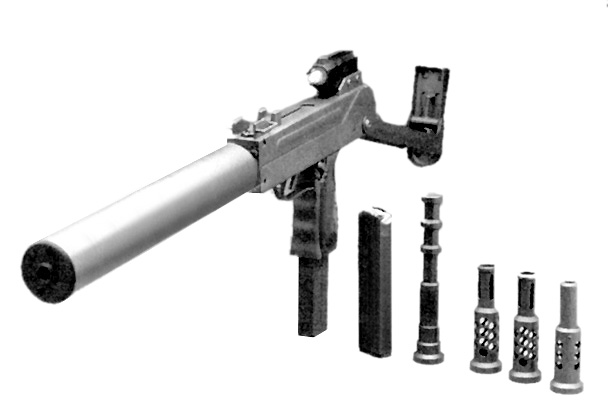
BXP.
BXP.

Characteristics

Caliber: 9x19mm Luger/Para
Weight: 2.5 kg
Lenght (stock closed/open): 387 / 607 mm
Barrel lenght: mm
Rate of fire: 1000 rounds per minute
Magazine capacity: 22, 32 rounds
Effective range: 50-100 meters
 
The BXP submachine gun had been developed in the South Africa by Mechem company for police and military use in mid-1980s and brought into production in 1988. It was designed due to significant shortage of arms in the South Africa due to international sanctions against regime. The BXP bears significant similarity to the American-made Ingram MAC-10 submachine gun, having similar general layout, receiver and bolt design, but with some improvements.
BXP is a blowback operated, selective fire weapon that fires from the open bolt. The receiver is made from stamped steel and consist of two halves - upper and lower. The bolt, in closed position, "sleeves" around the rear part of the barrel to save the overall length of the gun. The cocking handle is located at the top of the receiver. Unlike the MAC-10, the BXP has ambidextrous safety lever and separate fire mode selector, built into the trigger - when trigger is pressed partially, a single shot is fired; when trigger is pressed all the way back, gun fires in full-auto. Additional safety feature is a interceptor notch in the bolt that catches the bolt if it is released during the cocking but prior to be caught by the sear.
Another interesting feature of the BXP is a wide variety of muzzle devices, including silencers, heat shields, and even grenade launchers, that allow to fire non-lethal and explosive projectiles by the means of blank cartridge. BXP also features underfolding buttstock, made from stamped steel. The standard sights are of open type, but BXP can be equipped with laser aiming modules and collimating sights.
The rate of fire is relatively high at some 1000 rounds per second but BXP is said to be adequately controllable and accurate.

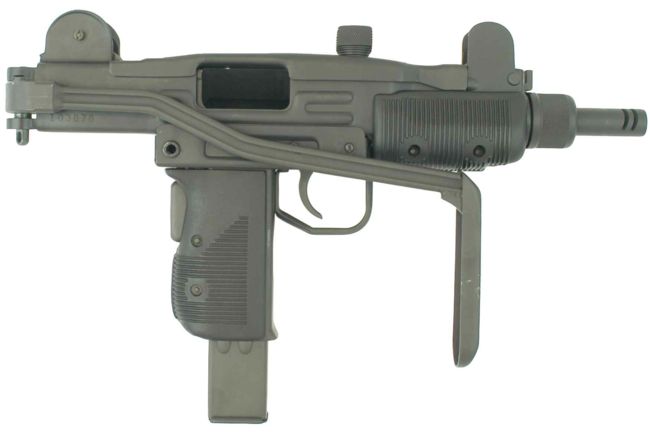
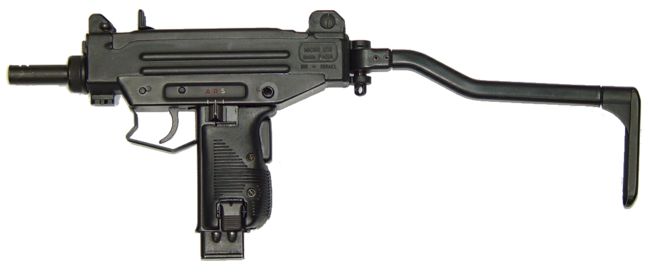
UZI / Mini UZI / Micro UZI submachine gun (Israel)

UZI / Mini UZI / Micro UZI submachine gun (Israel)

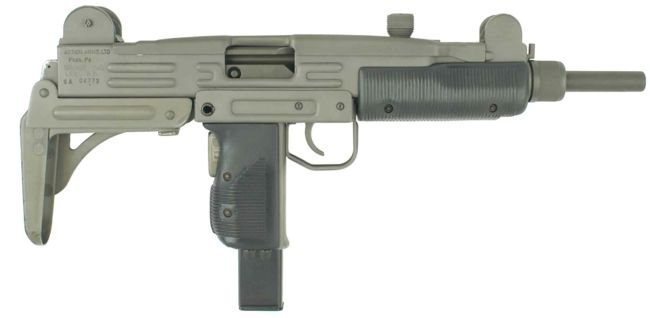
 Uzi submachine gun with metallic buttstock in opened position.
 Uzi submachine gun with metallic buttstock in opened position.
 
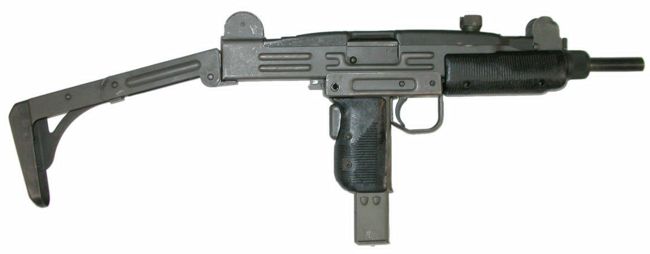
 Uzi submachine gun with metallic buttstock in folded position.
 Uzi submachine gun with metallic buttstock in folded position.
 
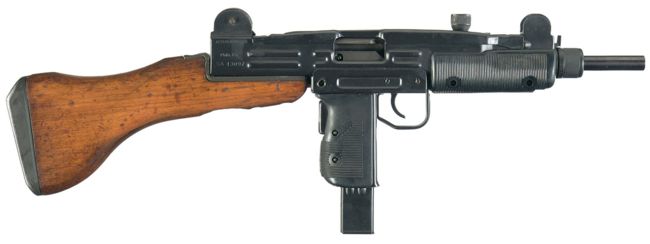
 Uzi submachine gun with fixed (detachable) wooden buttstock.
 Uzi submachine gun with fixed (detachable) wooden buttstock.
 
Mini-Uzi submachine gun with shoulder stock folded.
 Mini-Uzi submachine gun with shoulder stock folded.
 
Mini-Uzi submachine gun with shoulder stock opened.
 Mini-Uzi submachine gun with shoulder stock opened.
 
Micro-Uzi submachine gun with shoulder stock opened.
 Micro-Uzi submachine gun with shoulder stock opened.
 
 Micro-Uzi submachine gun with shoulder stock folded.
 Micro-Uzi submachine gun with shoulder stock folded.

Characteristics

  UZI Mini UZI Micro UZI
Caliber 9x19mm Luger/Para 9x19mm Luger/Para 9x19mm Luger/Para
Weight, kg 3,7 2,7 1,5
Length, mm (stock closed / open) 470 / 650 360 / 600 250 / 460
Barrel length, mm 400 197 117
Rate of fire, rounds/min 600 950 1250
Magazine capacity, rounds 25 , 32 20, 25, 32 20
Effective range, meters 200 100 30

The UZI submachine gun was developed in Israel by designer Uziel Gal in around1949, and manufactured by IMI (now IWI Ltd) since about 1951. UZI had been adopted by police and military of more than 90 countries, including Israel (now only in reserve), Germany, Belgium. It was also produced under license in Belgium by FN Herstal, and without license - in Croatia. More compact versions, Mini and Micro UZI,which were developed in 1982 and 1983, respectively, are adopted by many police, special operations and security units around the world, including Israeli Isayeret, US Secret Service etc.
An interesting question is the ancestry of the design of Uzi submachine gun.Most sources state that it was inspired by the Czechoslovak SA23 submachine gun, which also had magazine in pistol grip and wrap-aroundbolt. This submachine gun was adopted in 1948, with production commencing in 1949. There are some doubts that it could reach the shores of Israel the sameyear it was born. On the other hand, British army tested several prototype weapons of the same basic layout as early as 1944 (see MCEM-2),and it is possible that Uziel Gal had learned about this layout from UK. It is also possible that he "invented" this layout on his own - after all,the very same basic layout has been used in semi-automatic pistols for a good 50 years.
The UZI submachine gun is blowback operated weapon which fires from open bolt.Mini- and Micro-Uzi submachine guns are produced either in open-bolt or closed-bolt versions; in the latter variation, weapon is equipped with separate striker and additional spring. The receiver is made from stamped steel, with trigger unit and pistol grip pinned to its bottom at the center. The bolt is of "wrap-around" type,with most of its weight located in front of the breech face. The Micro-Uzi has an additional weight, made from tungsten, attached to the bolt, to slightly slowdown the overly excessive rate of fire. The cocking handle is located at the to pof the receiver cover, and does not move when gun is fired; the cocking handle slot is covered by sliding dust cover. Bolt handle is cut at the middle to provide a sighting channel. Gun is fitted with manual safety /fire selector, located on the left side of the grip, plus automatic grip safety at the rear. Full-size Uzi submachine guns were fitted either with a detachable wooden shoulder stock, or with under folding metallic shoulder stock of indigenous design. More compact Mini-Uzi and Micro-Uzi are fitted with side-folding metallic buttstocks made from steel.

Bullpup

Bullpup adalah konfigurasi senjata api, dimana mekanisme dan magazennya terletak di belakang pelatuk. Konfigurasi seperti ini meningkatkan perbandingan panjang laras terhadap panjang total senapan, yang memungkinkan membuat senapan yang larasnya sama dengan laras senapan biasa, tapi total panjang senapan lebih pendek. Keuntungannya selain lebih pendek, juga relatif lebih ringan.
Konsep konfigurasi seperti ini sudah muncul sejak sebelum Perang Dunia I, tapi baru dipakai secara luas pada tahun 1970-an.

Sejarah

Konsep ini pertama kali dipakai pada senapan bolt-action seperti Thorneycroft carbine pada tahun 1901, dan juga dipakai pada senjata api semi-otomatis tak lebih dari tahun 1936, ketika sebuah pistol bullpup dipatenkan oleh Henri Delacre dari Perancis. Sebuah senapan serbu eksperimental juga dikembangkan di Uni Soviet oleh Korovin pada tahun 1945. Dan Inggris sudah merencanakan memakai senapan bullpup sebagai senapan utama sejak 1944. Inggris mengembangkan dua desain, EM-1 dan EM-2, dan EM-2 akhirnya diadopsi sebagai senapan utama (secara terbatas) pada tahun 1951, tapi sayangnya terpaksa diganti dengan diadopsinya peluru 7.62 mm NATO

Pemakaian

QBZ-95, senapan bullpup buatan Tiongkok.
Bullpup mulai menjadi senjata militer utama pada tahun 1970-an, dengan diperkenalkannya Steyr AUG di Austria dan FAMAS di Perancis. Pada tahun 1985, Inggris juga mengikuti, dengan senapan SA80. Sekarang, bullpup sudah lazim ditemukan sebagai peralatan militer modern. Israel, Singapura, dan Tiongkok sudah merancang dan memproduksi senapan bullpup masing-masing. Senapan-senapan baru mayoritas adalah senapan bullpup, mengalahkan senapan baru konvensional.
Senapan bullpup juga mempengaruhi pasar senjata api sipil. Versi sipil dari bullpup militer cukup populer, dan sejumlah senapan bullpup khusus olah raga sudah ada yang dijual, seperti Bushmaster M17S dan Walther G22. Selain itu dijual juga perangkat modifikasi yang merubah senapan konvensional populer seperti AK-47 dan Ruger 10/22 menjadi konfigurasi bullpup

Steyr AUG

Steyr AUG adalah rangkaian senapan yang pertama kali diperkenalkan pada tahun 1977 oleh perusahaan senjata Austria Steyr Mannlicher. AUG adalah singkatan dari Armee Universal Gewehr, yang berarti "Senapan Tentara Universal". Nama Steyr AUG sendiri lebih sering digunakan untuk menyebut versi yang spesifik, yaitu varian senapan serbu bullpup kaliber 5.56 mm NATO, dengan warna hijau dan teleskop yang terintegrasi. Senapan ini sebenarnya telah memiliki banyak varian, mulai dari senapan submesin, senapan penembak jitu, sampai senapan mesin ringan. Senapan ini telah diadopsi menjadi senapan utama angkatan bersenjata Austria, Australia, Selandia Baru, Luxembourg, Irlandia, dan juga sempat dipakai oleh Malaysia. Satuan Polisi Khusus Indonesia yaitu Gegana Brimob Polri juga nmenggunakan Steyr AUG

Desain

AUG adalah salah satu senapan pertama yang menggunalan desain bullpup, yang membuatnya 25% lebih pendek dari senapan lain yang panjang larasnya sama, tanpa mengorbankan performa dan akurasi. Sebagian besar varian AUG dilengkapi dengan bidikan teleskopik 1.5x yang terintegrasi. AUG dianggap memiliki desain ergonomis yang modern. Fitur lain misalnya kemampuan dipakai oleh penembak tangan kanan maupun kidal, dan penggunaan bahan-bahan plastik transparan.
Laras Steyr AUG bisa ditukar-tukar dengan mudah, misalnya ke laras karabin atau ke laras lebih panjang. Bahkan AUG memiliki perangkat modifikasi yang bisa merubahnya menjadi senapan submesin. Varian lain, seperti varian senapan mesin ringan yang memiliki laras lebih berat, tak bisa dimodifikasi dan sudah diatur dari pabrik.

Varian

Steyr AUG A2, laras 407 mm.
Steyr AUG A3.
Steyr AUG 9 mm.
  • Steyr AUG A1 — Versi standar yang diperkenalkan pada tahun 1977. Awalnya hanya berwarna hijau dengan laras 20 inci.
  • Steyr AUG A2 — Serupa dengan A2, tetapi alat bidiknya bisa dicopot dan diganti dengan picatinny rail.
  • Steyr AUG A3 — Sudah banyak dimodifikasi. Memiliki picatinny rail yang terintegrasi pada bagian atas dan samping. Menggunakan peluru 6.8 mm Remington SPC.
  • Steyr AUG P— AUG A1 dengan laras lebih pendek.
  • Steyr AUG P Special receiver— AUG P dengan picatinny rail.
  • Steyr AUG 9 mm (AUG SMG/AUG Para)— AUG yang dimodifikasi untuk menggunakan peluru 9 x 19 mm.
  • Steyr AUG M203 — AUG dimodifikasi untuk menggunakan pelontar granat M203.
  • Steyr AUG LSW (Light Support Weapon) — AUG sebagai senjata pendukung ringan.
  • Steyr AUG HBAR (Heavy-Barreled Automatic Rifle) — AUG dengan laras lebih panjang dan berat, bolt tertutup, sebagai senapan mesin ringan.
  • Steyr AUG LMG (Light Machine Gun)— Berdasarkan AUG HBAR, tapi dengan bolt terbuka, dan alat bidik 4X bukan 1,5x seperti AUG biasa.
  • Stey AUG LMG–T— Sama dengan LMG, tapi dengan picatinny rail.
  • Steyr AUG HBAR–T— Senapan penembak jitu berdasarkan HBAR.
  • Steyr AUG Z— AUG A2 versi semi-otomatis untuk pasar sipil.
  • Steyr USR— AUG A2 yang disesuaikan untuk pasar sipil Amerika Serikat.
  • F88 Austeyr — AUG yang dimodifikasi untuk Australia.